Overview
EWB-UConn began working in La Prusia, Nicaragua, in late 2007 to address severe erosion and poor road conditions that made transportation challenging for 200 families. During the rainy season, heavy rainfall caused significant erosion along the Path of La Prusia, creating deep ditches and gullies, making the road difficult and, at times, impossible to traverse. The poor road conditions limited residents' access to essential services in the nearby city of Granada, including employment, medical care, markets, higher education, and other public services. The conditions also made it difficult for emergency vehicles and other essential services to reach the community.
The project initially focused on the redesign, stabilization, and construction of a permanent road connecting La Prusia with Granada. Through site assessments, surveys, and collaboration with local officials and community members, EWB-UConn identified erosion caused by stormwater as a major factor contributing to the deterioration of the road. EWB-UConn worked closely with Casas de la Esperanza, community leaders, the municipality of Granada, and other local stakeholders.
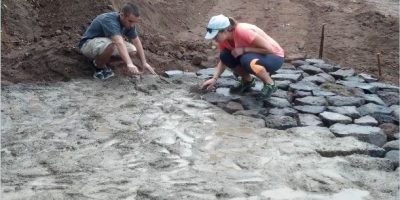
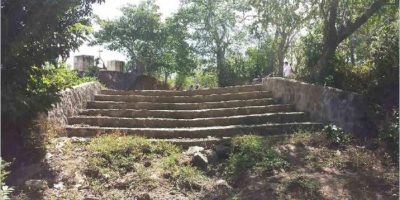
EWB-UConn developed a sustainable and cost-effective solution to reduce erosion along the Path of La Prusia. The project implemented a swale structure constructed using locally available volcanic rock aggregate and concrete to divert heavy rainfall runoff away from the road.
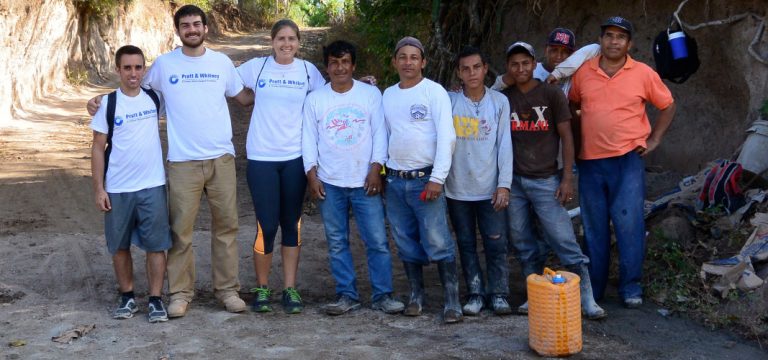
EWB-UConn visits Nicaragua to help construct a permanent road linking rural La Prusia.
Project Timeline
From 2007 to 2013, EWB-UConn conducted multiple assessment trips to understand the scope of the project, perform site surveys, and meet with community leaders and local officials. The team surveyed approximately 25% of La Prusia residents to better understand their needs and opinions regarding the road project. A detailed topographic survey was also conducted along 1.8 kilometers of roadway, along with watershed data collection to support the project design.
In January 2014, EWB-UConn traveled to La Prusia with a professional engineer to implement the erosion-control design. During construction, the location, dimensions, and grades of the proposed structure were adjusted based on the recommendations from the city engineer and community members. The project was relocated farther along the path of La Prusia, where it was determined to be more effective at diverting the stormwater.
In January 2015, EWB-UConn members returned to La Prusia to monitor and evaluate the project one year after implementation. The team assessed the structure and gathered feedback from local officials and community members. The project was found to have significantly improved mobility along the Path of La Prusia during the rainy season.
Following the successful evaluation, the project was officially closed out in Spring 2015. The completed erosion-control system was determined to be both effective and sustainable.
Sponsors
GEI Consultants, Inc., a geotechnical, water resources, environmental, and ecological consulting firm, generously sponsored the EWB-UConn trip to Nicaragua during Summer 2010.
University of Connecticut Civil & Environmental Engineering Department donated new, top-of-the-line surveying and rainfall-measuring equipment.
Special thanks to Gerald Hardisty, P.E., for his continuous work overseeing the project from start to finish.